Pag-IBIG Contribution: What You Pay, How to Verify, and When You Can Withdraw
Your employer deducts money from your paycheck for Pag-IBIG every month. You wonder if it is posting correctly, how much you have accumulated, and when you can access it.

Your contribution forms the foundation of your Pag-IBIG membership and determines your eligibility for loans and benefits. Understanding what you are contributing, how to verify it, and what you can do with it puts you in control of your account.
What Is a Pag-IBIG Contribution
A Pag-IBIG contribution is money set aside from your income as part of your Pag-IBIG membership. For employed members, your employer deducts this automatically from your salary. For self-employed members, you pay it voluntarily. This money accumulates in your account, earns dividends, qualifies you for loans, and becomes available for withdrawal when you meet specific conditions.
Pag-IBIG is a government savings program where your contributions stay in your account and grow for your eventual benefit. Your contributions are not gone—they accumulate and remain yours throughout your membership.
Mandatory vs. Voluntary Contributions
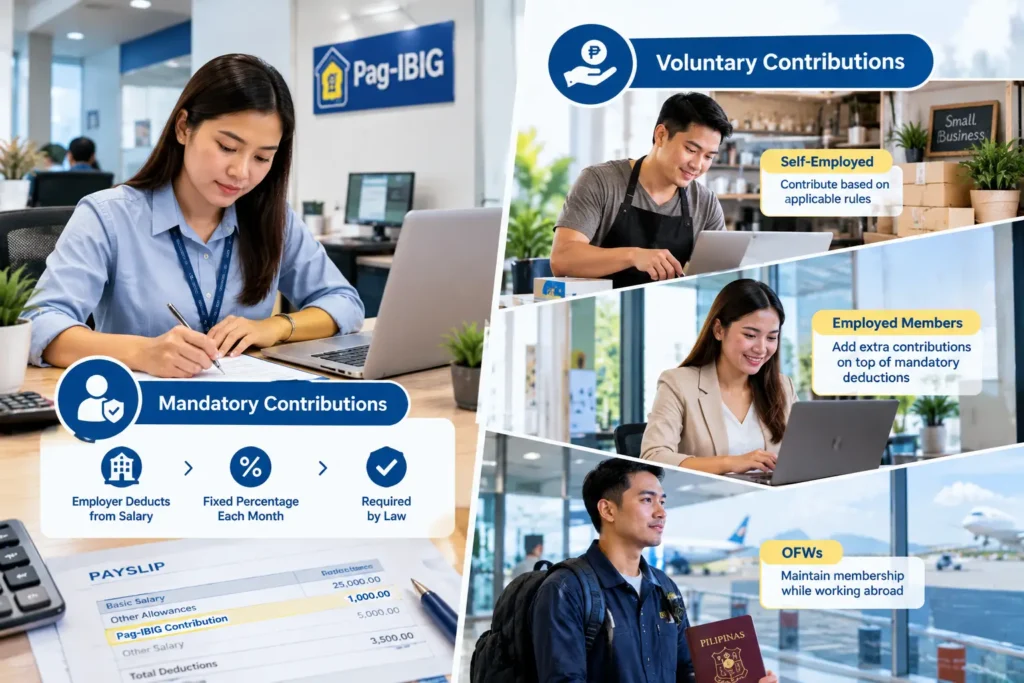
Mandatory Contributions:
Private employees are required by law to contribute. Your employer deducts a percentage from your salary each month automatically. This is non-negotiable employment law.
Voluntary Contributions:
Members can contribute more than required. Self-employed individuals who are under mandatory coverage rules contribute according to those requirements. Employed members can add extra contributions on top of mandatory deductions. OFWs maintain membership through contributions while working abroad.
Contribution Rates for Employees
The current contribution for private employees consists of an employee share (deducted from salary) and an employer share (paid by the company). The exact percentage varies based on salary level and current Pag-IBIG regulations.
For specific 2026 rates, refer to official Pag-IBIG documentation, as rates are subject to periodic adjustment by government policy.
Understanding Your Contribution Statement
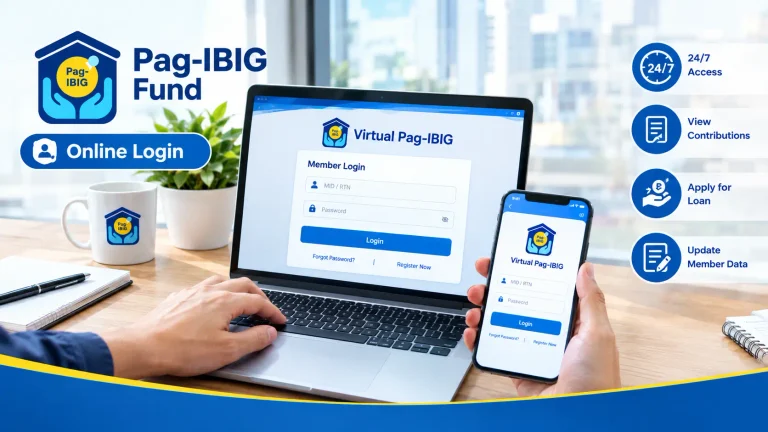
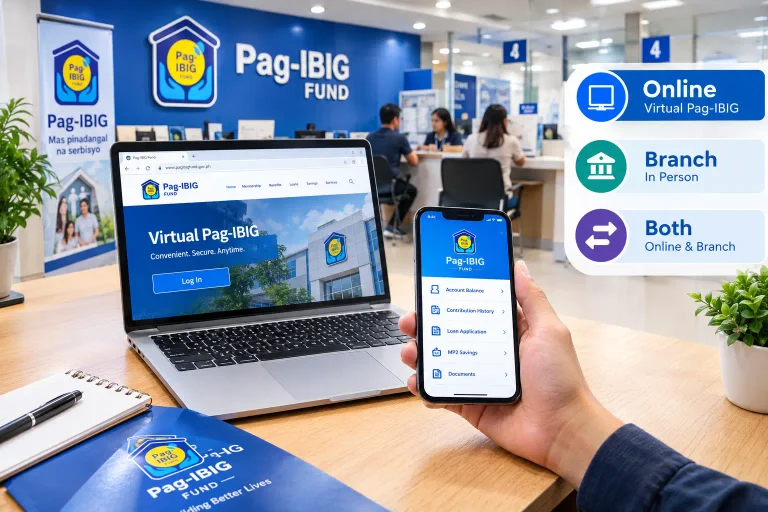
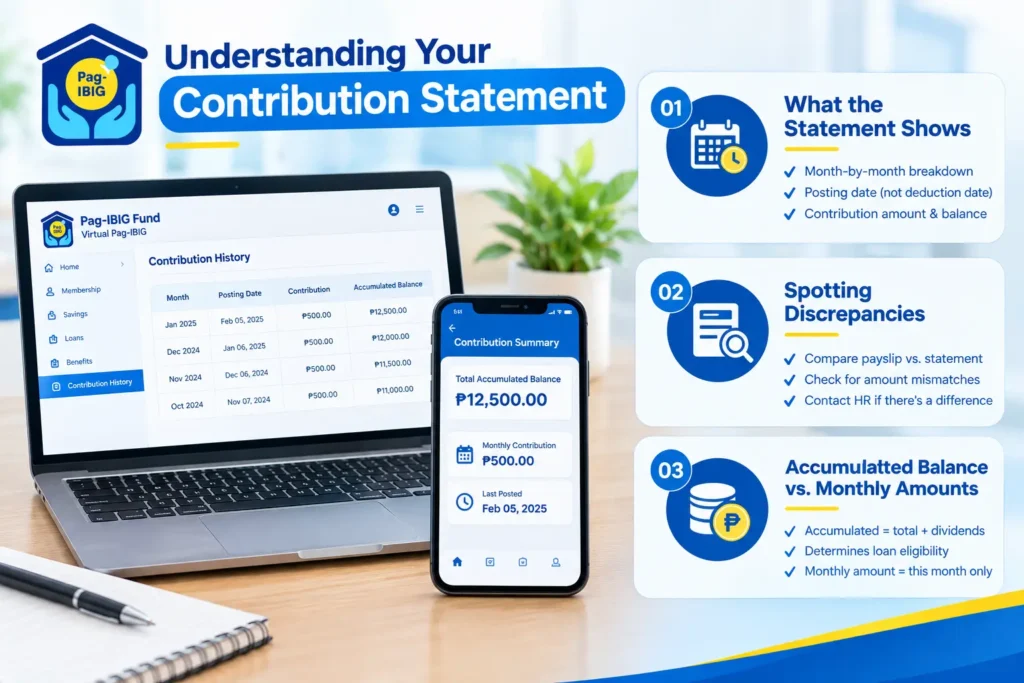
When you log into Virtual Pag-IBIG, your contribution history displays month by month. Each entry shows the posting date, contribution amount, and accumulated balance. Understanding how to read this statement helps you spot issues early.
What the Statement Shows:
The month-by-month breakdown displays when contributions are posted, not when they were deducted. A contribution deducted in January might be posted in February depending on employer remittance timing. This distinction matters when investigating missing contributions.
Spotting Discrepancies:
Compare your payslip deductions against Virtual Pag-IBIG postings to ensure amounts match. If your payslip shows a PHP 500 deduction but Virtual Pag-IBIG shows PHP 400, contact HR immediately. Discrepancies suggest calculation errors, system problems, or intentional underpayment—all require immediate investigation.
Accumulated Balance vs. Monthly Amounts:
Your accumulated balance shows total contributions plus dividends earned over your entire membership. This accumulated amount determines your loan eligibility and eventual retirement benefit. Monthly amounts show only that month’s contribution, not your total.
How Contribution Rates Are Determined
Pag-IBIG calculates contributions based on multiple factors depending on your membership category.
For Employed Members: Two components make up the total: employee share and employer share. Both are based on the same salary figure but are separate obligations.
For Self-Employed Members: This flexibility allows self-employed members to adjust contributions based on business performance.
For OFWs: OFW contribution amounts vary based on declared foreign income. Many OFWs contribute the same amount monthly regardless of income fluctuations, treating contributions as a fixed priority obligation.
Income Verification: All contribution calculations assume accurate income reporting. If your declared income or reported salary is incorrect, your contribution calculation is also incorrect. Updating your member information with Pag-IBIG when salary changes ensures contribution calculations remain accurate.
The Importance of Contribution Consistency
Missing contributions creates downstream problems that extend far beyond simply having less accumulated savings.
Loan Eligibility Impact
Loan eligibility depends on multiple factors. Official requirements typically include minimum membership savings history, recent posting activity, sufficient accumulated value, income verification, and account good standing.
Benefit Calculations:
Some Pag-IBIG benefits depend on consistent contribution history, not just total amount.
The length of continuous contribution may determine eligibility
for certain programs or affect benefit calculations.
Maintaining Eligibility:
Simply restarting contributions after a gap does not immediately restore loan eligibility. Typically, you must demonstrate three to six months of resumed contributions before becoming eligible for new loans again. The timeline varies by loan type.
Contribution Payment Safety and Best Practices
Paying contributions correctly ensures your money reaches your account without complications.
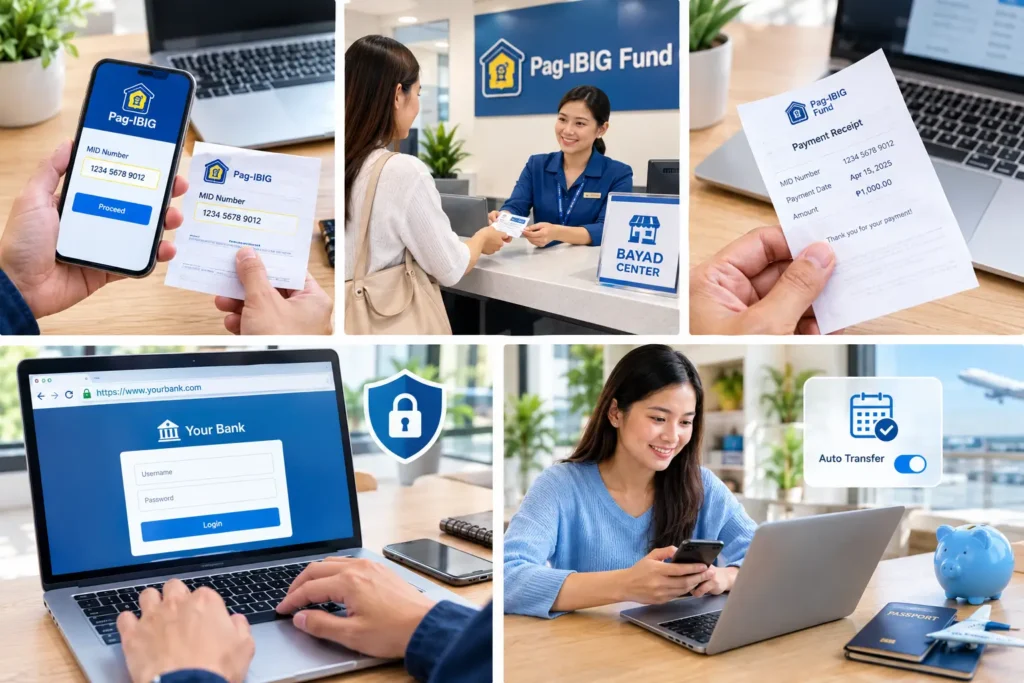
Verify Your MID Before Payment: Every contribution payment must include your correct MID number. A single digit wrong can direct your contribution to another member’s account. Always double-check your MID before finalizing any payment.
Use Official Channels Only: Pay contributions only through official Pag-IBIG channels: authorized banks, Bayad Centers, online banking platforms, or direct branch payments. Never pay through unofficial intermediaries claiming to represent Pag-IBIG.
Save Payment Receipts: When you pay at a bank or Bayad Center, request and keep your receipt. If your contribution does not appear in your Virtual Pag-IBIG record within a reasonable time, provide this receipt to Pag-IBIG or your bank as proof of payment.
Online Banking Security: When paying through online banking, ensure you are using your actual bank’s official website or app. Phishing sites designed to look like banking portals steal credentials and payment information. Verify the URL is correct before entering login details.
Automatic Transfers for Consistency: Set up automatic monthly contributions through your bank’s recurring payment feature. Automation ensures you never miss a payment and removes the need to remember. OFWs especially benefit from automatic transfers when managing finances from abroad.
Troubleshooting Contribution Problems
Contributions Showing in Payslip But Not on Virtual Pag-IBIG:
Your HR department deducted the money and submitted it to Pag-IBIG, but the portal processing can take time. Check back after a few days. If contributions still do not appear after an extended period, contact your HR to verify they submitted the remittance on schedule.
Contribution Amount Seems Wrong:
Calculate what your contribution should be: your gross monthly salary multiplied by the current employee contribution percentage. If the deduction differs, ask your HR department why. Common explanations include mid-month hire dates (partial month contributions), salary adjustment, or computation errors that HR can correct.
Gaps Between Expected and Actual Contributions:
A gap usually means your employer did not remit for that month. Possible reasons include temporary company closure, payroll system problem, bankruptcy, or intentional non-compliance. Contact your HR to understand what happened. If HR cannot explain it or refuses to investigate, contact Pag-IBIG directly.
Online Payment Rejected But Money Debited:
If your bank debits your account for a Pag-IBIG payment that fails to process, contact your bank immediately with your transaction details. Banks can usually track failed payments and either reapply them or issue refunds.
Multiple Deductions in One Month:
If your payslip shows double contributions, contact HR to investigate. Possible causes include system errors that posted the same deduction twice, or intentional duplicate deduction (rare but illegal if true). HR should correct this within the pay period or issue a refund in the next payroll.
Contribution Consolidation Process
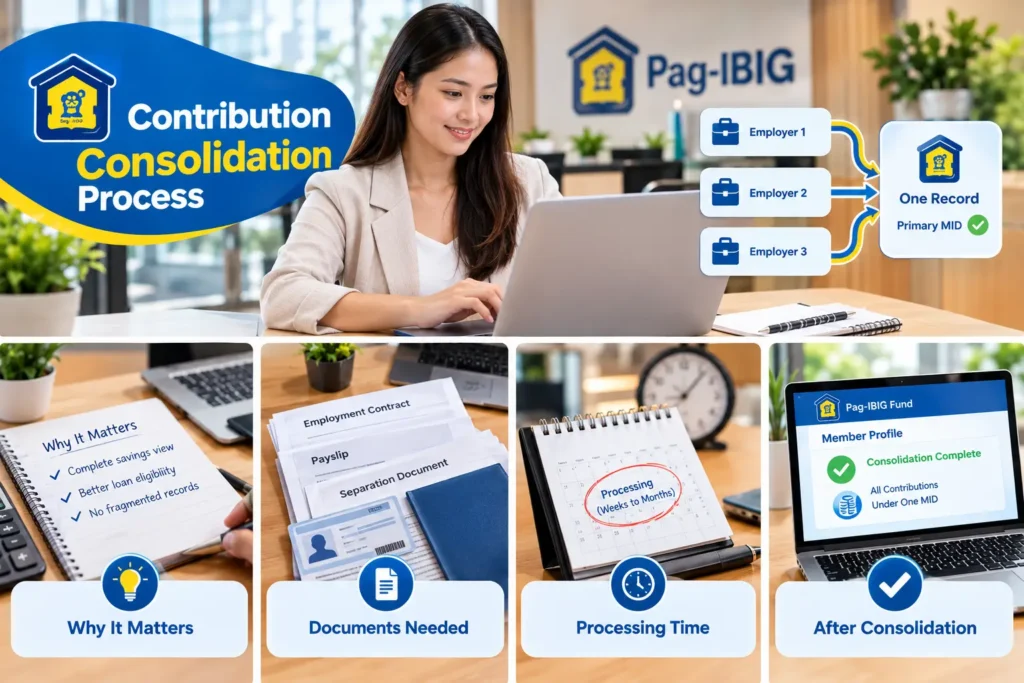
Members with work history spanning multiple employers sometimes accumulate contributions in separate fund records. Consolidation merges these into one primary MID.
Without consolidation, your accumulated savings are fragmented across multiple records. Loan officers cannot see your complete savings picture. You might be told you are ineligible for a larger loan because one record shows insufficient balance, when your total across all records is actually substantial.
Bring employment contracts, payslips, or separation documents from each employer showing your previous employment and MID numbers (if known). The more documentation you provide, the faster consolidation processes.
Consolidation is not instantaneous. Pag-IBIG must verify each employer record and your identity, then merge the accounts. The process typically takes weeks to months depending on workload.
Once merged, all contributions appear under your primary MID. Future contributions go to this single record. You no longer need to track multiple accounts.
Withdrawal Eligibility and Procedures
Understanding when you can access your contributions is critical for retirement planning.
Withdrawal of Contributions
Pag-IBIG savings may be claimed under several qualifying conditions. These include membership maturity after meeting required savings period, optional withdrawal after specified tenure of membership, retirement at age 60 or beyond, permanent total disability, and certain critical illnesses.
The specific eligibility requirements and procedures depend on the withdrawal type and your membership circumstances. To determine which options apply to you and to begin a withdrawal claim, contact your nearest Pag-IBIG branch with your MID, government ID, and relevant supporting documentation. Branch staff can explain your withdrawal options based on your current membership status.
Contribution and Retirement Benefit
Your contributions represent your personal retirement benefit. Unlike pension programs where benefits come from a pool, your Pag-IBIG retirement benefit comes directly from your accumulated contributions and earned dividends.
Calculating Your Retirement Benefit: Your accumulated value at retirement includes all contributions you made plus all dividends earned over your membership. This total is what becomes available to you.
Dividend Rates: Pag-IBIG declares annual dividend rates for each year based on fund performance. Your contributions earn these declared rates. Higher dividend years means faster accumulation.
Projected Retirement Amount: You can estimate your retirement benefit by reviewing your current accumulated value and projecting forward using historical dividend rates. However, actual future dividends depend on fund performance, which cannot be predicted with certainty.
Planning Considerations: Members should plan for retirement assuming conservative dividend rates rather than peak rates. This provides a more realistic picture of available funds.
Contribution Payment Methods
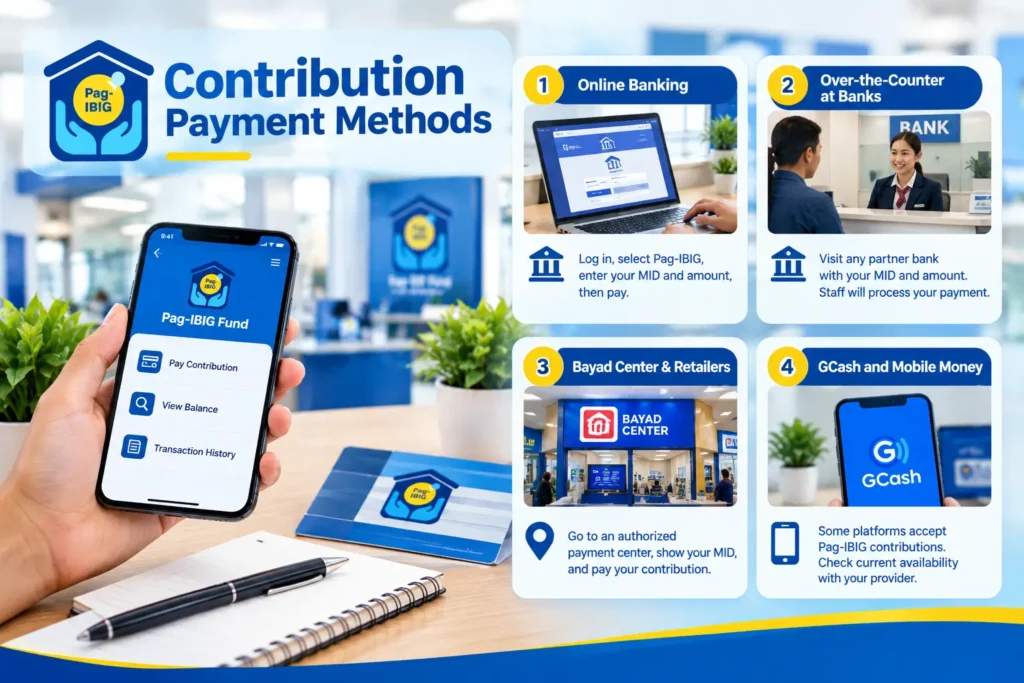
For Self-Employed and Voluntary Contributions:
Online Banking:
Log into your bank’s online platform, select Pag-IBIG payment, enter your MID and amount, and complete the transaction.
Over-the-Counter at Banks:
Visit any partner bank with your MID and desired amount. Staff process the payment, and funds reach Pag-IBIG within days.
Bayad Center and Retailers:
Authorized payment centers throughout the Philippines accept Pag-IBIG payments. Visit any location with your MID and pay your contribution amount.
GCash and Mobile Money:
Some platforms accept Pag-IBIG contributions. Check current availability with your service provider.
MP2: Voluntary High-Yield Savings
Pag-IBIG II (MP2) is a separate voluntary savings program offering higher dividend rates than regular contributions. Members enroll independently and choose monthly contribution amounts. MP2 accumulates separately from regular contributions but both are part of your Pag-IBIG membership.
MP2 is popular with self-employed members and those seeking accelerated savings.
Contribution Requirements for Pag-IBIG Loans
For specific loan eligibility requirements for your membership status, contact a branch or check Virtual Pag-IBIG after login to see available loan options and maximum amounts based on your actual account status.
What Happens If You Stop Contributing
However, gaps in contributions affect loan eligibility. A member with no contributions in the past year may not qualify for new loans, even with substantial accumulated savings. Resuming contributions typically restores eligibility within months.
For employed members, gaps occur only during job transitions or unemployment. If you anticipate a gap, contact Pag-IBIG to understand your options for maintaining membership during transitions.
OFW Contributions
Overseas Filipino Workers maintain membership through voluntary contributions while working abroad. Contributions can be made through Philippine banks, remittance centers, or authorized money transfer services.
Many OFWs arrange automatic monthly transfers to ensure consistent contributions while working abroad. OFW contributions follow regular rules: they accumulate in your account, count toward loan eligibility, and generate dividends.
Employer Obligations
Employers must contribute a percentage of each employee’s salary to Pag-IBIG as a separate cost beyond employee deductions. Employers must remit both employee-deducted and employer-paid contributions to Pag-IBIG within specified deadlines.
Missing remittance deadlines creates penalties and affects employee contribution posting. Employees should verify on payslips that contributions are deducted and periodically confirm on Virtual Pag-IBIG that contributions are posting.
Contribution Consolidation
Members who worked at multiple employers sometimes have fragmented contribution records. Consolidation merges separate records into a single account under your MID number, ensuring all accumulated savings are visible and eligible for loans as a combined total.
To consolidate, contact Pag-IBIG with documentation showing previous employment and old MID numbers or fund records.
Best Practices for Managing Your Contributions
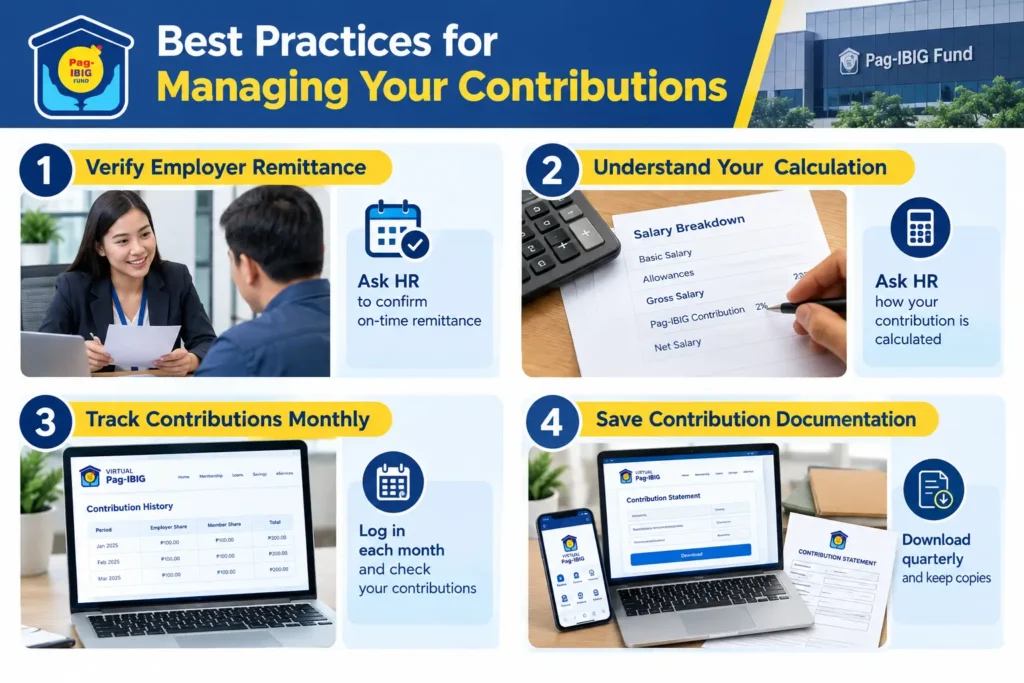
For employed members, periodically ask HR to confirm they are submitting contributions to Pag-IBIG on schedule. This proactive verification prevents months of posting delays.
Ask your HR department to explain how your contribution amount is calculated based on salary. Understanding the math prevents surprises when you see deductions. If the amount seems incorrect, ask HR to clarify.
Set a calendar reminder to log into Virtual Pag-IBIG each month to verify contributions posted correctly. Most members check only when they need something (applying for a loan), at which point gaps are discovered late. Monthly verification catches problems early when they are easiest to resolve.
Download your contribution statement from Virtual Pag-IBIG quarterly. Store digital copies and keep one physical copy. If you ever need proof of contribution for employment or government purposes, having your records speeds up the process significantly.
Contribution and Loan Amounts
Your contribution history directly determines loan eligibility and size.
Minimum History Required: Pag-IBIG loan programs have specific membership savings requirements. For current details on your loan eligibility, contact a branch or use Virtual Pag-IBIG to check what options are available for your membership status. Requirements vary by loan type and current policies.
Maximum Loan Amount: Your accumulated contributions and contribution rate affect your maximum borrowable amount. Members contributing significantly have greater borrowing power than those contributing minimally.
Account Good Standing: Your account must have no delinquent payments. If you have unpaid obligations, loan eligibility remains suspended until settled.
Contribution Trends and Planning
Understanding contribution patterns helps members plan for retirement and loans.
Historical Contribution Rates: Contribution rates have adjusted periodically based on government policy. Current rates may differ from when you joined. Your Virtual Pag-IBIG account shows your actual contribution history with historical rates applied.
Inflation Impact: Over decades of membership, inflation affects the real value of your accumulated contributions. A PHP 1 million balance today has different purchasing power in twenty years. Members approaching retirement should consider inflation in planning retirement expenses.
Dividend Importance: Contributions alone do not create retirement funds—dividends are equally important. Dividends compound significantly over decades of membership, increasing your accumulated value over time. However, future dividend rates are not guaranteed and depend on fund performance.
Contribution Acceleration: Members can accelerate savings by increasing voluntary contributions during good years (bonuses, business growth). Even small additional amounts compound substantially over 20+ years of membership.
Contribution for Future Planning
Your current contributions shape your financial future. Understanding the connection helps members make better decisions.
Retirement Income Source: Your accumulated contributions plus dividends are your primary Pag-IBIG retirement benefit. Irregular contributions mean lower retirement income. Consistent contributions compound into substantial retirement funds.
Loan Preparation: Members planning future loans should ensure they have met the applicable membership savings requirements and have their income documentation ready for the application.
Emergency Fund Building: For self-employed members, contributions also serve as forced savings. The discipline of paying contributions monthly creates accumulated emergency reserves for hardship situations.
Financial Goal Alignment: Members with specific goals (home purchase, family business startup) can time voluntary contributions to align with loan applications, maximizing both savings and borrowing power.

Common Contribution Myths Clarified
Myth:
My contributions are gone if I stop working
Reality: Your accumulated contributions remain permanently in your account. They cannot be taken away due to employment changes.
Myth:
My employer keeps part of my contribution as profit.
Reality: Your entire contribution goes to your personal Pag-IBIG account. Employers contribute separately from employee deductions.
Myth:
I can access contributions anytime before retirement.
Withdrawal is possible under several conditions including membership maturity after required savings period optional withdrawal after tenure.
Frequently Asked Questions
Conclusion
Your Pag-IBIG contributions are not money disappearing into government—they are your savings accumulating in an account that belongs entirely to you. The discipline of consistent contributions, whether through automatic payroll deduction or voluntary self-initiated payment, builds the foundation for loans, dividends, and eventual retirement security.